CdWO4 Scintillation Crystal

Need help?
We help you find the right solution. We offer support, service, calibration and training for all our products. Contact us for a service agreement!
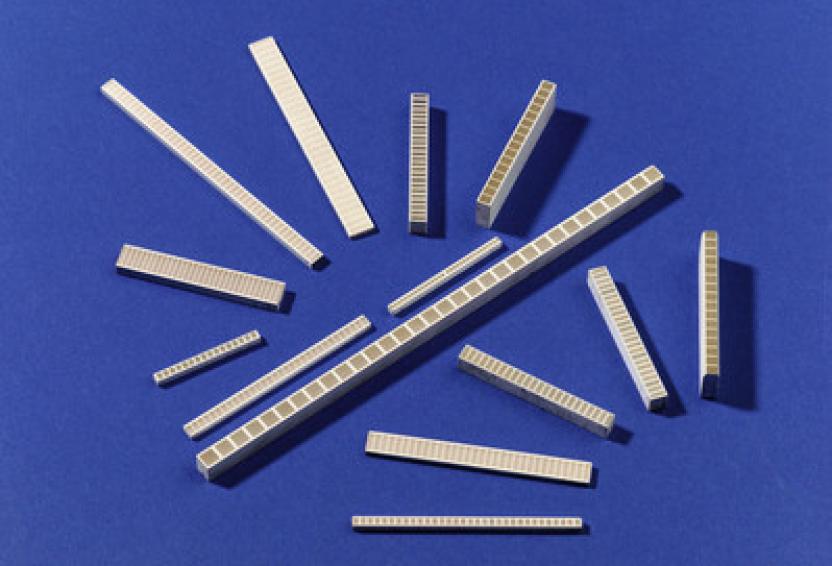
Service & reparation Request a quoteCadmium tungstate (CdWO4) is a high density, high atomic number scintillator with a relatively high light yield. The emission maximum is at 475nm and the total light output is 12 to 15 photons/keV. The light yield relative to NaI(Tl) on a bialkali PMT is 30 to 50%.
The high light output and low afterglow make it ideal for use with silicon photodiodes in detectors for medical and industrial Computed Tomography (CT) scanners. It has very good radiation resistance, and its temperature dependence is small in the 0 to 60oC range. Its high density makes it a good choice for 300+ keV imaging for security luggage, container and vehicle scanning for security.
The intensity of the scintillation emission of CdWO4 (irradiation with γ-rays) at room temperature (25oC), the curve is relatively flat (-0.1%/oC) which can be important for some applications. For further technical information, see IEEE NS, Volume 41, No. 4, August 1994.
The intensity of the scintillation emission of CdWO4 as a function of wavelength distribution is a good match to photodiodes. CT scanners for high and low energies have been built with CdWO4. A long decay time of 14000 nanoseconds is not a drawback for CT scanners or other systems that operate with a current-mode readout.
Furthermore, CdWO4 has a low afterglow. This is important in preventing glare and streaking in the generated images and allows for faster processing.
Contact
Stefan Mårtensson
- Sales - Radiation Detection
- Phone: +46 (0)18-566803
- Mobile: +46 (0)76-8265837
- stefan.martensson@gammadata.se
