Digitizer 2745 series

Need help?
We help you find the right solution. We offer support, service, calibration and training for all our products. Contact us for a service agreement!
Service & reparation Request a quote- High channel density: up to 64-channel, 125MS/s 16-bit ADC programmable input range, individual DC offset adjustment.
- Digital pulse processing and waveform recording of 64 or 8 independent detectors.
- High-resolution Nuclear Spectroscopy: multiport MCA operating in PHA, PSD* modes.
- Open FPGA architecture for pulse analysis algorithm customization.
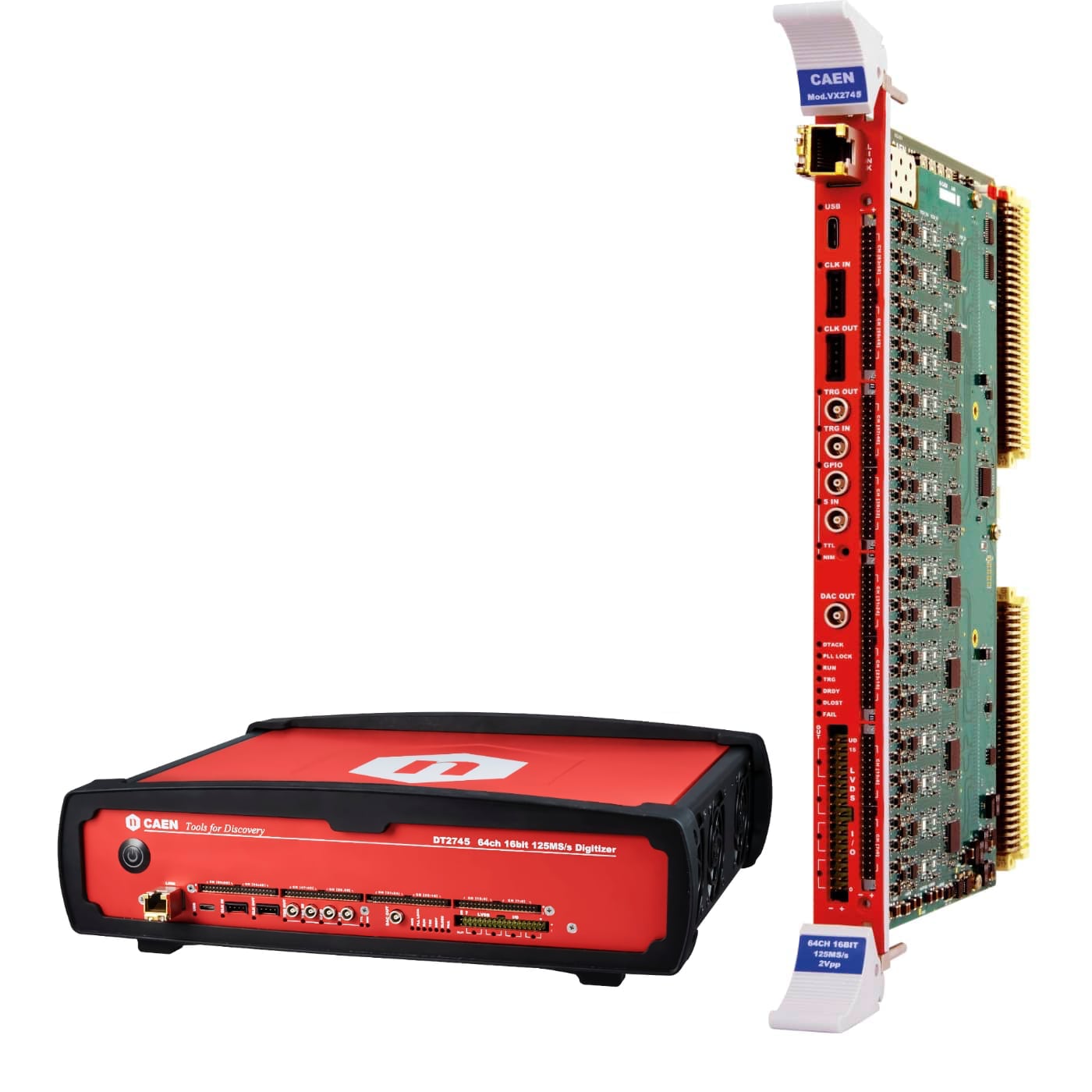
- Available in VME64, VME64X and Desktop form factors.
- Easy synchronization of multiple units.
- Front panel readout via USB-3.0 type-C or 1/10 Gigabit Ethernet
The 2745 Digitizer Family is a digital signal processing solution for radiation detectors, available in multiple form factors: VME64 (V2745), VME64X (VX2745), Desktop (DT2745) (64 channels) and Desktop Lab (DTL2745) (8 channels).
It offers not only waveform digitization and recording but also Multi-Channel Analysis for nuclear spectroscopy using silicon strip detectors, segmented HPGe, scintillation detectors with PMTs, wire chambers, and others.
The 2745 family can perform pulse height measurements (PHA), constant fraction timing (CFD), charge integration (QDC) and pulse shape discrimination (PSD) independently for each channel, providing a versatile and high-performance solution for a wide range of applications in nuclear and particle physics, spectroscopy and detector development.
Analog input channels with VGA (Variable Gain Amplifier), software-selectable up to x100, are available as differential inputs on 2745 versions or single-ended inputs on 2745B versions. Each channel of the module digitizes the analog input signal, typically coming from a physics detector, through a 16-bit, 125 MS/s ADC. The sampled data are used to initiate the digital pulse processing sequence, managed in the FPGA at the firmware level. Different firmware types can be selected via software, according to the specific setup and acquisition mode.
- Common trigger: all channels acquire simultaneously with a common trigger. The trigger can be fed externally or generated by a combination of individual channel discriminators. This mode is mainly intended for the acquisition of waveforms, like a digital oscilloscope. Options for zero suppression are available to remove not significant data.
- Independent trigger: suited for trigger-less applications, where no global trigger is needed but each channel acquires waveforms upon its self-trigger which fires through a digital discriminator, independently of the others.
- DPP: real-time processing in the FPGA allows for the extraction of physical parameters from the waveform (e.g. pulse height, charge, timestamp, PSD), well suited for high counting rate applications. It is yet possible to save both raw waves and parameters.
Data sheet
Contact
Toni Kansanoja
- Sales - Radiation Detection
- Mobile: +358404824356
- toni.kansanoja@gammadata.fi
